
Interview with Mack Carruthers
 Mack Carruthers grew up in a small, small town where a creative imagination and a knack for storytelling developed into a passion for animation in high school. Mack graduated from Computer Arts program at Durham College in 2007 and three months prior to graduation, Mack was hired to work on Nickelodeon’s Emmy award winning The Backyardigans and has since worked on Macy’s Presents Little Spirit: Christmas in New York and Guru Studio’s / Disney Jr’s Justin Time.
We featured Mack’s brilliant independent short film “Snowdrifter” as a quick pick back in June. The short has been officially selected at TAAFI 2012, Vimeo festival 2012 and won the Best Canadian Short Film at TAIS Showcase 2012. We spoke to Mack about “Snowdrifter” and his passion for animation…
Where did the idea for snow drifter come from?
The first idea of snowdrifter happened while I was attending a ‘writing for cartoons’ workshop panel at the 2008 Ottawa International Animation Festival. Luckily, I happened to be doing more doodling than listening at the time. I turned two haphazard circles into a cute looking snowman standing in the middle of a snowstorm. I quickly grew attached to the little doodle and it sparked the idea of Snowdrifter!
Can you tell us a bit about the process of making snow drifter?
Snowdrifter was a challenge because it was created on nights and weekends while working full time as an animator for television. I designed the short to be simple to create ( one character, basic props, environments etc) but animation deadlines at my day job as well as life in general, often got in the way of production. Even though the short took a fair amount of time to make, the process was still a fun challenge I refused to give up on it.
As for my process, I brainstormed the story using the mighty Windows Notepad first. I jumped over to character design and art direction using Photoshop afterwards. Storyboards were also done in Photoshop but my focus was to create a fully coloured animatic from the start. My intention was to get ideas into edit as quickly as possible to see how well they transitioned into playback. (“Strike while the iron is hot”, so to speak.) If something wasn’t working, or if a new idea came to be, I’d draw out the new panels I needed and sent them back to adobe premier for an edit test. Snowdrifter would have eight separate versions by the time I finished the animatic. Each one was integral towards finding the best version of the story.
The rest of the production was fairly standard. Maya was used exclusively for modeling, rigging, animation and rendering for the film. However, environment and backgrounds were completely faked using digital paintings created in Photoshop. Rendering was done using faked GI dome lights and toon shaders, which heavily supported the original art direction. Adobe After Effects and Adobe Premier were used for the final composite and edit.
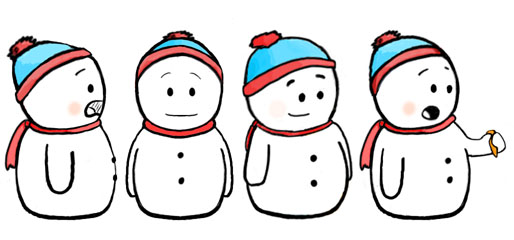
You state on the films vimeo page that the film endured many revisions and challenges, can you tell us a bit about these?
I spent a large amount of my time having to learn new skill sets during the production of Snowdrifter. This was because I had an unrelenting interest for animation when I was in college, so I intentionally neglected most of the technical aspects of Maya in order to spend more time animating. When I started making the assets for Snowdrifter, I had to revisit character rigging as a whole. Rendering and compositing also had their own learning curve and share of setbacks but the simplicity of my short saved me from many headaches!
The biggest challenge was how to properly use the feedback I received from friends and co-workers. Witnessing every reaction between orange juice coming out the nose to deeply unsettled confusion was a nail biting experience. It’s hard to not doubt the quality of your work with each negative reaction because they demand much more attention than positive reinforcement. I took note of the suggestions and made the mistake of trying to apply all of them instead of only using the advice I felt would make a stronger film. There were some fantastic suggestions but others pushed the film toward a diluted experience or gave away the twist of the film.
Learning the difference between critisms that add to your film rather than take away was the key to feedback use. In the end, creative choices you make might not resonate with the entire audience because art is so subjective and that’s ok! Receiving honest feedback is important but not letting it effect the confidence to move forward was the challenge for me. For a short time, my confidence fell through and Snowdrifter sat untouched for at least a month. It would take a while to find the balance of personal expression and critisism without sacrificing the feel of the story I wanted to tell. In the end, it was worth all the trouble!
An example of advice that made its way into Snowdrifter: When the dead snowmen were reveled in the first cut of the animatic, it was a held shot on what you see as the first frame of the pan that’s in the final film. My animation supervisor, Andrew Harvey, suggested I pan across, showing an entire town of nose-less snowmen. Taking that advice pushed Snowdrifter in a much funnier and darker direction, keeping the vibe of the film intact! Awesome!
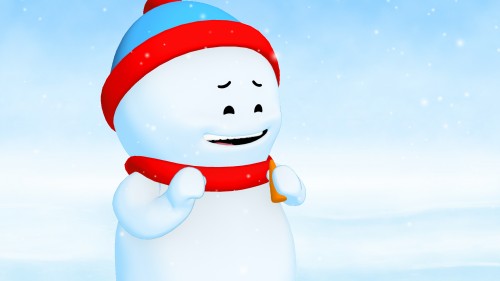
The cute/evil twist in the film is brilliant and is clearly what strikes a chord with the audience, how did you approach the balance of adorable vs evil, and did you find it difficult in executing this twist?
Thank you! Originally, Snowdrifter was going to be 100% adorable, but the evil twist came into the works early on during the storyboard process and gave the film a much darker direction! It was somewhat difficult making sure the twist wasn’t given away because of small plot hole. “How can the snowman survive without a nose?” was the most common response I received when I screened the animatic to friends and family. They were absolutely right to ask that question because I never fully addressed it, even in the final film. I made versions of the story that fixed the issue but showing that the snowman needs a carrot nose to survive, foreshadowed the ending way too much. My goal of the film was to make a character piece that introduces, but not focusing on, plot elements that hint at something more. There have been many short films that give too much of a wink and a nudge on where it’s headed. I really enjoy being surprised, so focusing on establishing a lovable character was flat out fun for me and also massively supported the twist ending. Like a good magic trick, the character keeps the audience engaged, eventually veering off in an unexpected direction that makes for a memorable surprise!

Will we be seeing the little snowman in any future films?
I would love to continue the Snowdrifter story. Whether it’s a longer short film or an episodic web-series, there’s many more stories left to tell! However, I’d need more free time and help in order to pull it off in a reasonable time frame. The best case scenario, I’d storyboard some new ideas and shop it around for funding. Perhaps a kickstarter campaign is in order?
Is there anything you would change about the film?
All of the sound design and mixing was rushed and that was a mistake. The audio needed more patience and care, both of which I didn’t have by the time post audio was on the to do list. I should have gotten professional help that was available to me but I decided to keep in independent with a $100 microphone, my somewhat sound proof closet and a gaming headset. It sounded like a good idea at the time. 😉
Did you always want to become an animator?
Oddly enough, my first career aspiration was palaeontology, but I was 5 years old at the time and easily detracted by colours. Video games eventually became my obsession and I seriously considered being a programmer for games early on in high school, although my artistic side was too strong and demanded attention. An animated gif assignment in high school opened my eyes to animation. I had an embarrassingly late eureka moment when I learned that animation for games and movies was something people do for a living. Right then, I just knew it was perfect for me. All of my interests and talents wholeheartedly pointed in that direction. I’ve been tunnel visioned on animation ever since!
Where does your inspiration come from, not just for snow drifter but in your creative work as a whole?
Thats a great question! This one stumped me for a while. I think that anyone who is really passionate about their interests is highly inspiring. Someone with a Joie de vivre, or a quirky spot of character also does the trick. All it takes is something positive that I can relate to or respect that makes me want to create or improve. Keeping your eyes open to life and comedy around you helps ten-fold. I keep a notepad filled with odd and humorous things I’ve seen or heard around the city. Reading them always jogs the creative juices. As an example, I saw rather intimidating looking man in army fatigues buying pink cupcakes once. How funny is that?! There are treasures out there in your life to see. Take some time to look and get inspired!
You started out at Durham College before moving straight into Nickelodeon to work on the Backyardigans, Do you have any words of advices for aspiring animators hoping to get into the industry?
Absolutely! Assuming you’re a student, the most important thing to do is to spend time animating outside of class assignments. I know that sounds frighteningly hard, but it’s important to practice what you’ve learned and I’ll tell you why. Say you’re about to graduate and you’re relying on animation class assignments for your demo reel; your reel will be showcasing animations created when you were only learning the fundamentals. Comparing a reel made of school assignments to a reel made by a student who spent time meticulously animating original work, will have a striking difference in the eyes of an employer in terms of quality and originality. I’m sure there’s still talent to be found in assignment based reels but other students may be using the exact same assignments to showcase their talents. Which makes your reel less unique and likely to be tossed aside by employers looking to be impressed. The students who take that extra step in their work stand out like fruit on a tree; employers will notice. So take the opportunity that school gives you and push your animation skills. Take that extra step. If you’re to be an animator, chances are you’ll be having the most fun animating your own creations in the first place. It’s cliché, but practice makes perfect. You can do it!
What animation projects are you working on at the moment?
At the moment, I’m rather stuck with indecision on what to work on next! I have a handful of short film ideas and art pieces that haven’t seen the light of day in a while. I’ve also been heavily detracted with the idea of creating a video game. Due to my inexperience with programming, the task feels a bit daunting. Whichever the outcome, the next project is guaranteed to have some great laughs! I can’t go a day without a giggle or two.
What animated film do you wish you could have made?
I feel like I should pick something brimming with beautiful animation… but I have to go with “Dr. Tran: Quiet Log Time”. It’s wonderfully simple, brilliantly timed and unexpectedly hilarious!


