
Tale of the Princess Kaguya – Review
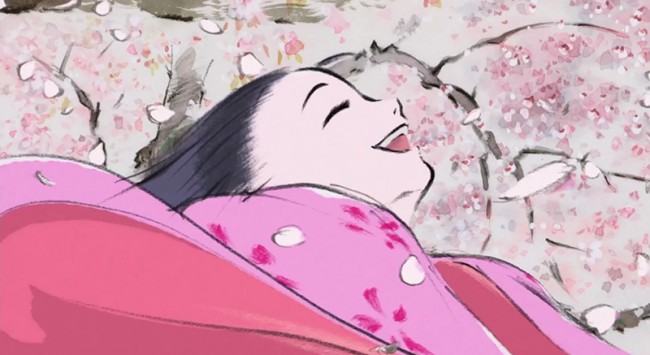
Japanese director Isao Takehata, co-founder of Studio Ghibli, has created something very special with The Tale of the Princess Kaguya, directing a brand new process of soft sketchy drawing that only a few top animators found they could emulate. For someone to be directing an animated film in his seventies and eighties is remarkable. He has made sacrifices along the way: “I wish I still smoked” he says after the first successful screening of the long-awaited film.
Here is a 10th century traditional Japanese fairy tale of a girl whose destiny it is to leave her rural upbringing and join the nobility. Over one hundred actresses were auditioned for the prized part of the Princess. Almost a fairy tale in itself.
I wonder what Dolce & Gabbana with their view of ‘synthetic’ children would make of this film? A childless couple adopt a miraculous tiny woman-child found in a bamboo shoot in the forest. Lil’ Bamboo, as she is known by the local gang of peasant children, grows at an alarming rate and lives life at an accelerated pace.
This is unromantic rural life, with nomadic peasants scrabbling for food , and breastfeeding their babies (possible the first time I’ve ever seen this in an animation but please put me right).
Cut to the mansion Lil’ Bamboo’s adopted father arranges for her so that she can live as a real princess, paid for by a convenient gift of gold the lunar spirits leave in the bamboo plantation.
The fledgling Princess is a free-spirited heroine who runs around the mansion delighted in her new wardrobe of expensive clothes, but baulks at having her eyebrows plucked. She treats everything as a game, but then excels – both at her studies and her music.
As soon as she comes of age, a dismal party of two (the Princess and her comical but loyal maidservant) are partitioned off from the main celebrations while the men celebrate. In a brief mental escape, the Princess stripped of all her riches returns briefly to her childhood rural home only to be mistaken for a beggar and sent away with a bowl of food.
Her fate is sealed. She has been named as a princess and has to marry into the nobility. When her suitors offer comparisons of her beauty to rare treasures, she requests that they bring these treasures to her. The suitors attempt this, with one fatal consequence, and the Princess is dismayed at her power.
Finally, the Princess escapes the clutches of the most eligible bachelor in the land by a feat of mind-power which gives her an insight into her immediate future.
No-one, not even the armed defenders of the newly fortified mansion or the singing peasants, can defend the Princess from her final surreal destiny.
The style of the animation resembles a picture-book brought to life. This is how Winnie the Pooh should have been made. The posters on the London underground right now advertising the Goya exhibition are very similar in style, full of sketchy characterful brushstrokes.
In one particular solo ‘flight’ scene there is a radical change of style with the use of a reduced colour palate and blurred angular movement – rather like Ralph Steadman’s drawings – to suggest drama and speed.
The film is closely edited by the director Isao Takehata himself. Just the removal of six frames from a particular scene where the Princess weaves her way towards the camera manages to subtly change her movements.
The words were recorded first and the animation was drawn around them. What you are unaware of is the likeness of the drawn characters to the actors portraying them, and the effort that went into the vocal expressions. For that reason I hope the animation is widely shown with subtitles rather than the dubbed version.
The music ranges from purely descriptive, to Philip Glass-minimalism, to celebratory Hare Krishna. The song over the closing credits, sung by a female singer-songwriter, is out of character but serves as a bookend to the slightly bewildering finish.
Who are these lunar spirits who leave a tiny woman-child in a bamboo forest and fill a sapling with gold? Whoever they are they remain illusive until the end.
Related Posts


About The Author

